Friday, 28 July 2006

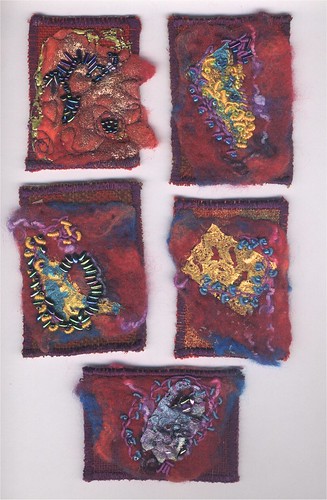
fibre ATC's for Dale

I made these ATC's to send to Dale for the Thread Studio/WA Stitches & Craft show swap, it's my first try at fibre ATC's, I look at other fibre ATC's and post cards and see that it's acceptable to have unfinished raw edges but I just don't feel happy doing it, and it is so hard to get a neat satin stitch on something so small, probably should have allowed more time to perfect them, as it is I'll have to put them in an express post bag to get them to Western Australia by next Wednesday. Hope they pass muster, Dale is showing some great ATC's already received on her blog.

These have some felting, tyvek and beads and hand embroidery

Fibre ATC

Friday, 21 July 2006

Singer sewing machine model 66

Chloe commented on me getting the Peter Pan machine for $20 and said it doesn't get better than that...
but it does!

Several times a year our council has a cleanup and people put their junk out on the footpath for collection.

Daughter loves walking around checking out the piles of discards, but I always had reservations about going through someone's rubbish - dates back to my childhood when I went to "town" (Sydney) with my mother and she would delight in looking in the skips in the laneways behind the factories - I would huddle so embarrassed in the corner hoping no one would see us.

So one cleanup day, daughter said "knowing how you feel about going through the junk, I don't suppose you want to know about the old sewing machine in the next street"
we hi-tailed around there in record time, but I made her get out of the car and do the picking up,
(will have to work on getting over my delicate sensibilities)

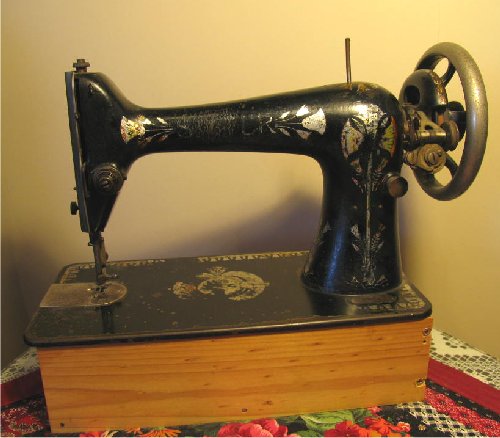
The machine is a Singer model no 66 made in 1906

Singer sewing machine

Thursday, 20 July 2006

purple scrumbles

I really love making crocheted scrumbles, a relaxing no-brainer way to occupy your hands while watching TV, but my problem is always what to do with them, they multiply so quickly and I've tried the full poncho approach and it is too much, visually overpowering and so heavy to wear (makes a good warm knee rug)

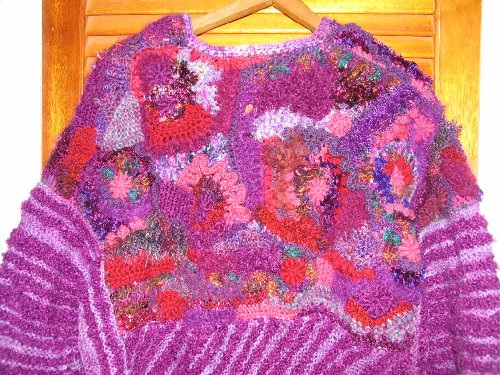
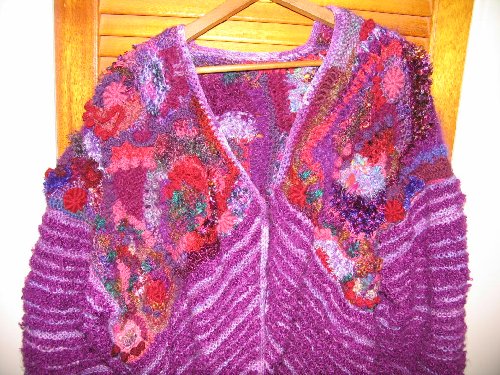
I had a nice little collection of purple-ish coloured pieces and put them together into a yoke, then had to come up with a body and sleeves for them.

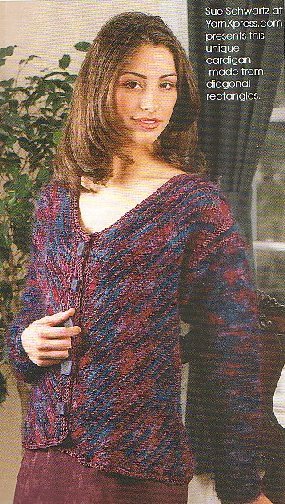
I tried the diagonal/vertical cardigan II free pattern from Yarnexpress.
This is the picture from their site:


This pattern has a unique sizing method, the size is adjusted by adding vertical bands to the sides, after the shoulders are sewn together.

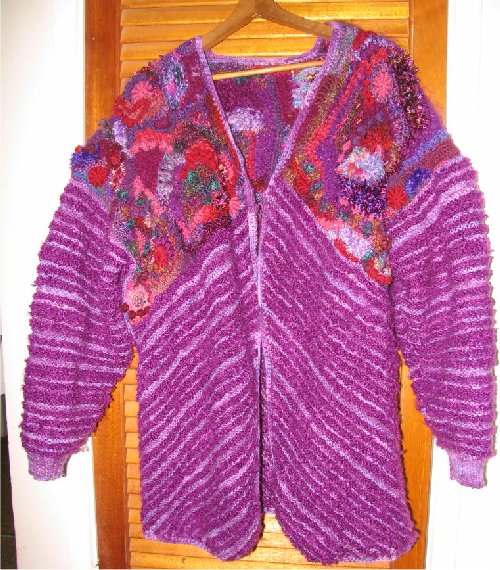
and this is mine:
Scrumbled jacket

I reversed the left and right fronts (made the left my right) so I could make use of the v shaping to fill in with the scrumbles.

In retrospect this wasn't a good idea, the front corners of the jacket droop, which I think is related to the corner shaping coming down to a point there, I can see the opposite corner as in the pattern would have held the shape a lot better.
(the front corners have actually curled back on themselves in this pic, taken before pressing)
This all sounds like double dutch but if you have a look at the pattern picture then compare way the rows of knitting fall to my picture it might make more sense.

Anyway the purple monster is finished and I've worn it to the local shops and didn't leave a trail of gaping mouths in my wake, so I guess that's a good sign.....or not...

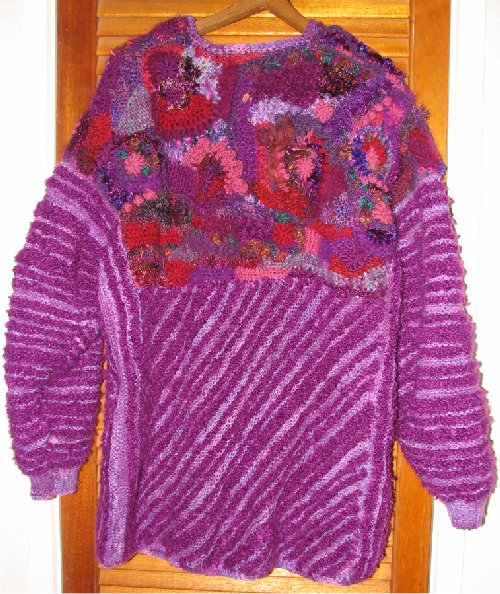
Back view:
Scrumbled jacket

Scrumbled jacket

front view:
Scrumbled jacket

Wednesday, 19 July 2006

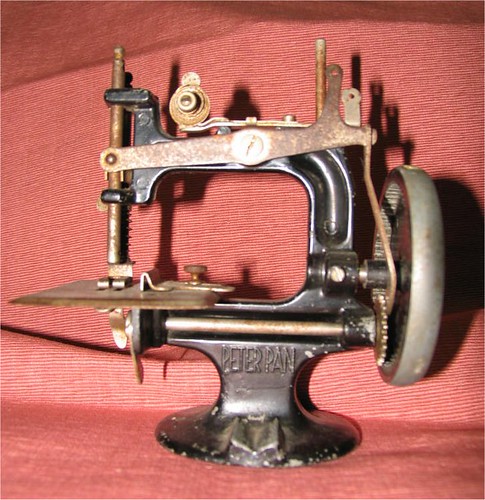
Peter Pan sewing machine

I promised Chloe I'd show my sewing machines

Peter Pan sewing machine

This is the first of them, I had a similar one when I was about five years old but goodness knows where it finished up, not with me.

This one I bought at a trash and treasure market in the Blue Mountains about 4 years ago for AU$20 - it had a price of AU$25 on it and when I offered the money, the man selling it took off $5 because the handle was broken.
There is one currently on ebay for AU$275 (no bids)the ebay seller says it is Circa 1940.

The Needlebar says it was made by Colton, Palmer & Preston who operated in Adelaide, South Australia between 1842 and 1965.

Mine appears to be Model Type: Peter Pan Model 0 because it does not have embossed writing on the turn wheel, only the arrows as in the pictures on the above site.

sorry for the quality of the photo, not good snapping at night - might do another one.

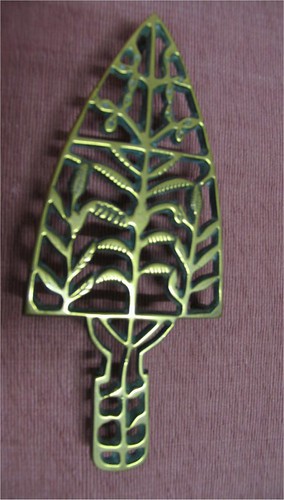
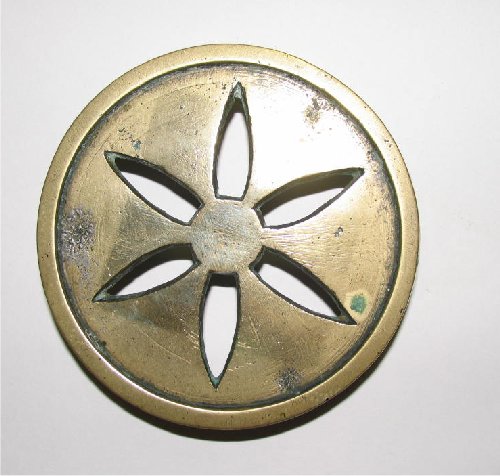
another trivet

I found another trivet hiding away, the joys of clutter, you continually make interesting discoveries without leaving home

brass trivet

Tuesday, 18 July 2006

receiving the pages


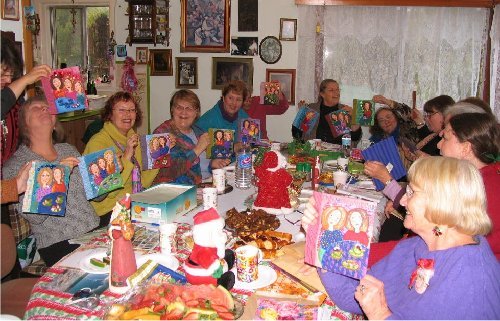
...and here are the girls showing the pages they received from me


Some of the comments on flickr were wondering how I will bind it -

one of the swap ladies made us each a fabric cover, she made very wide covers with the idea that we would wrap the covers right around the stack of pages and close with a button, but even with the width she has allowed I think the pages will make too thick a stack to fit in the cover.

I also remember seeing a fabric book with beads between each page as a spacer which I rather liked, I think they need to have a separation or maybe a stiff cardboard spacer between them - I've ordered Pam Sussman's book from Amazon so might wait til it arrives and gather ideas.

fabric books - what not to do

I had a little production line going, a stack of pages in progress to one side of my sewing machine.
To save rethreading the machine, I was going through each page and sewing all the red thread, then again with all the brown threads etc.
I got so carried away at one stage that I didn't notice I'd picked up two pages and I managed to satin stitch them both together, EEEEKKK!!!!
(well, I said something a little stronger than eeeekk)
fabric book page
the top page was OK, I just had to unpick and restitch along the same lines, but the bottom page was left with a row of tram tracks right through my coffee cups and up the bodice of the girls dress

fabric book page - what NOT to do

I was able to cover the lines through the dress with sequins but not the other unpicked lines, so I decided to keep this page for myself.

I was at the stage where I couldn't face the idea of painting another page!!

fabric book

I'm a little late with this post - I've already had the photos up on flickr and receiving comments for a couple of days, I wrote about the beginnings of the fabric book swap here in June.
Last Saturday I met with the Ladies Who Lunch and we had a wonderful Christmas in July party and exchanged our pages, the pages were all so clever and I'm so lucky having such talented friends. I'll take pictures of the pages I received and show them later this week.
for today, here are the remainder of my pages - altogether they made quite an impressive stack!

Edited 8 August:
I've been reading Susan on Case Notes from the Artsy Asylum
In todays' post she has asked that we choose a post from our blog that we think deserves to be highlighted, edit it to add a link to her post and before the end of today (8th) send a TrackBack and 'wait for the magic to happen'

Not sure if Australia is a day ahead or a day behind the US, so I may not get this right.I'm not even sure if I'm getting the trackback thing right, haven't done this before but ...I was really pleased with my pages so would like to show them off to a few more people..so here goes!!!


fabric book page

fabric book page

fabric book page

fabric book page

fabric book page

fabric book page

fabric book page

fabric book page

fabric book page

Saturday, 1 July 2006

trivets

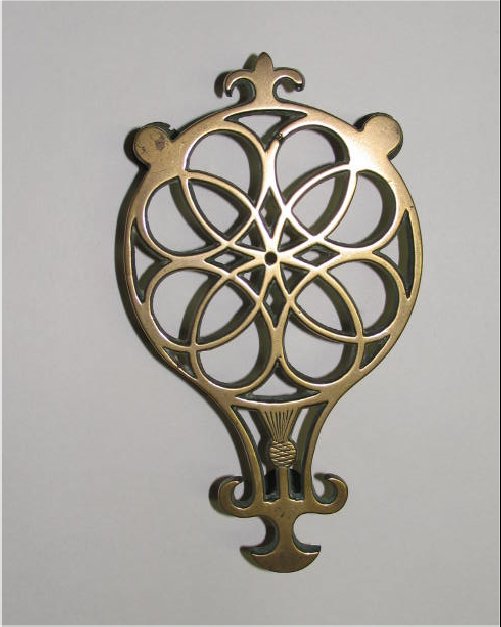
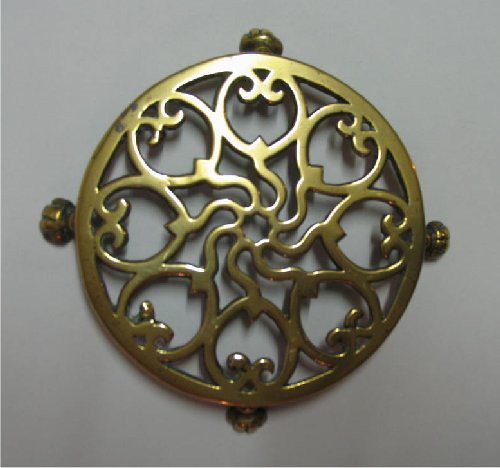
Next for Chloe I'm showing my trivets made by my grandfather, William Spalding.

William came to Australia from Scotland in 1884, aged 18, with his parents and siblings. The family settled in Balmain, Sydney and William became a foundryman at Cockatoo Docks.
He enjoyed his work so much that he set up a small back yard foundry at home and made many pieces of ornamental castings including these trivets.

On the handle of this one you can see the scotch thistle symbol of his homeland.

brass trivet

brass trivet

this next is still in daily use under my electric jug, it's a nice feeling to be able to use something made by an ancestor and have a sense of family continuity.

brass trivet

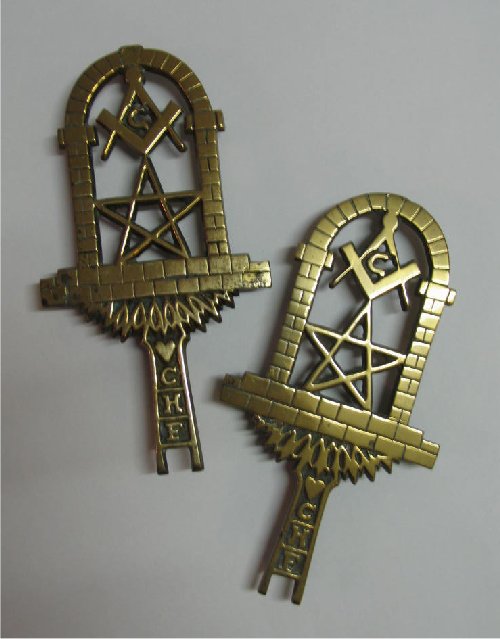
These next two were obviously cast from the same mould and show the Mason's symbols, as far as I know William was not a freemason, but did belong to a lodge, I don't know the full history of freemasonry and lodge connections, but from the little I've read, I think they were all tied in - more research needed.

brass trivets


OK Chloe, what's next in the collection? this is fun!

flat irons

I'm easily led astray so when I read Chloe's post I wanted to play too.

Chloe has started a Flickr group for antique irons and trivets

so I firstly had to dig out my granny's irons for some photographs:

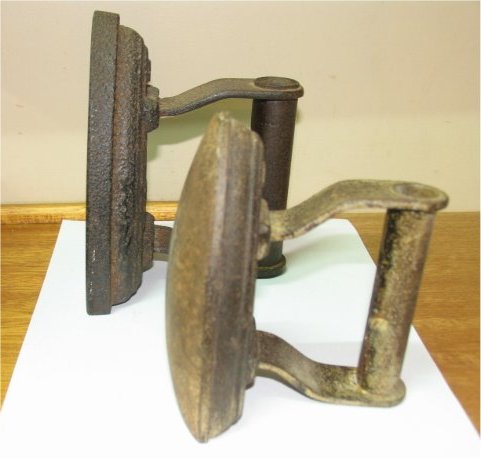
I'd puzzled over the name on two of them, the iron had eroded and it was difficult to read, but the symbol under the name was the same as the one on Chloe's iron, so these two of mine are clearly Salter irons as well. In addition to the Salter name and symbol is Silvesters Patent.

I really need to do some research on these.
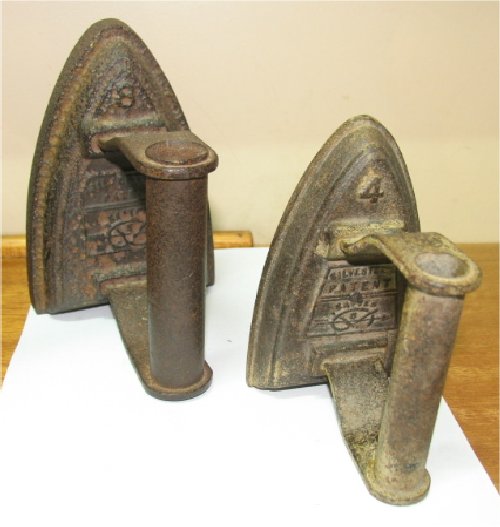
Salter irons
Salter irons

The one at the back is a flat iron and at the front is a polishing iron, it has a rounded base.
After pressing stiffly-starched collars and shirt fronts, one polished them by dampening the surface very slightly and rubbing the hot polishing iron backwards and forwards over the work at great speed.
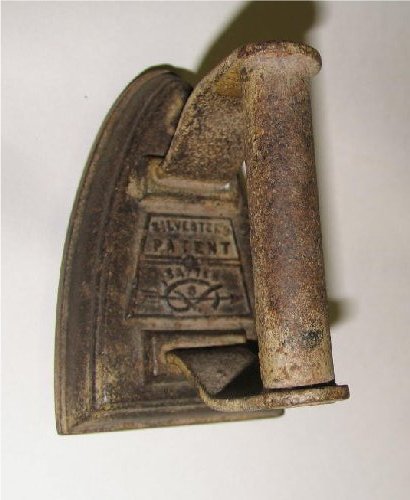
polishing iron

this next is another polishing iron

polishing iron

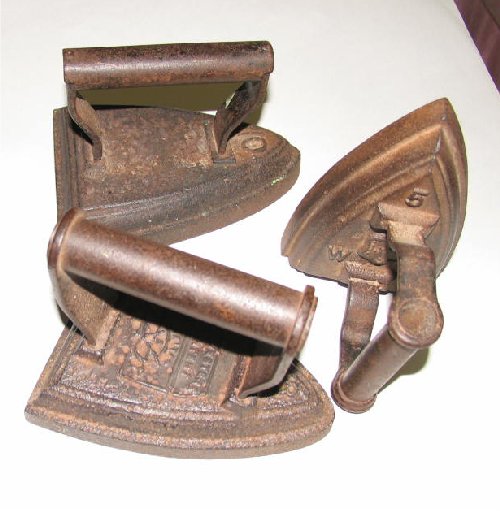
flat irons

this shows all three of my flat irons together, the one at the back has no brand and the iron on the right is also corroded and hard to read - again, I think some research will turn up the correct brand.
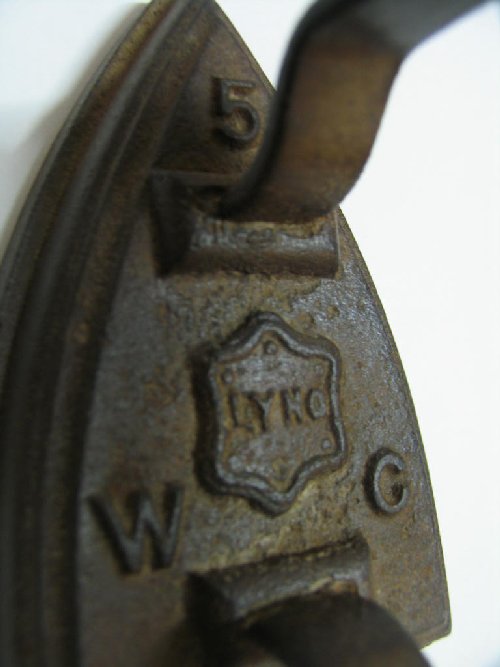
flat iron

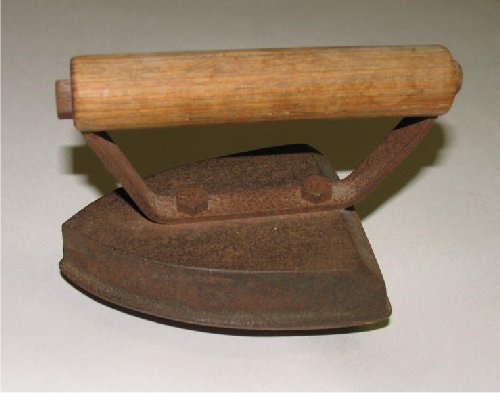
Lastly is this little one, it was given to me to play with when I was a child, I don't know if it was originally a child's toy, or maybe for a young girl to use to learn domestic skills - can't say it did much to improve mine! and I was certainly never allowed to heat it on the stove, which, given my record with hot things, was probably for the best
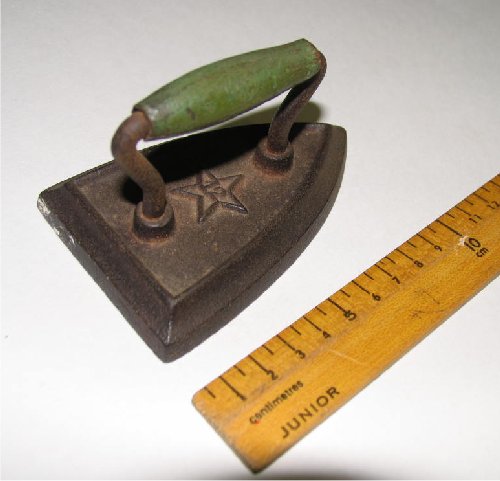
small flat iron

additonal:
have just been looking at the Powerhouse Museum site (Sydney) and found my Salter iron - it's called a 'sad iron'and is circa 1890-1900's
http://www.powerhousemuseum.com/collection/database/?irn=262885&search=iron

...and I'm not sure now about my 'goffing' iron (that was what my mum called it) I've found a 'goffering' iron that looks nothing like mine - still looking

found a little clipping on irons from The Australian Home Beautiful 1965 (it pays to be a hoarder!)
what I had been calling a goffing iron is really a polishing iron - after pressing stiffly-starched collars and shirt fronts, one polished them by dampening the surface very slightly and rubbing the hot polishing iron backwards and forwards over the work at great speed.

The flat irons were heated on top of a stove.
For best results they had to be rubbed over bathbrick, then over sacking impregnated with paraffin wax, and finally dusted. Heat was lost fairly quickly, so changes were frequent.

I looked up bathbrick and it seems to be a powdered brick similar to pumice - it's used today by bookbinders when working with gold leaf, they put it on the cutting pad to prevent the gold leaf sticking to the pad.

Goffering tongs were scissor shaped with round 'blades' - after a frilled garment had been ironed, the tongs were used to produce a fluted effect to the fullness of the frill.

And in the days before irons? in Scotland the laundry was beaten flat and smooth with an implement rather like a rolling pin with one handle, called a 'beetle'

who would want to be a washerwoman?
Related Posts with Thumbnails