I think I've shown this perspex book here before, but I've just put the photos together in movie maker, and added music - Windows movie maker is a really basic programme but it's been very interesting (well, for me anyway, because I'm so nerdy!!) I've learnt how to crop and splice music clips and add them to the movie along with titles.
...AND you can listen to the mellow vocals of Australia's new minister for environment, heritage and arts....with added seagulls
EDITED: sorry this video was removed because YouTube wrote to me and pointed out I was breaching copyright by using the music - even though it was a very tiny grab and I gave full credit, I thought it would have fallen under the fair use policies but apparently not.

The chronicles of Erica, a textile and mixed media artist living in Sydney, Australia, as she meanders her way through a life filled with fabric, clay, paper, glass and dolls ..... and dragons
Friday, 30 November 2007


Tuesday, 27 November 2007
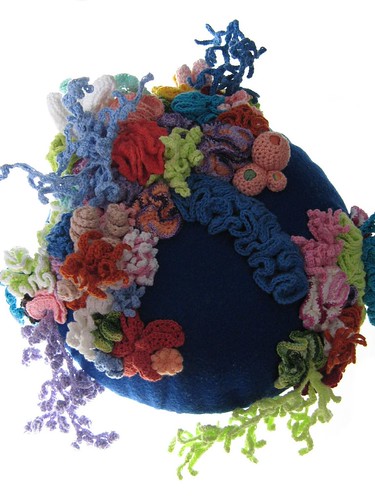
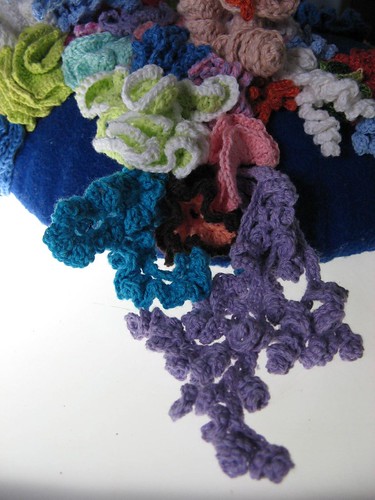
Hyperbolic coral reef - a work in progress
When I was at school I decided I didn't like and wasn't going to waste precious daydreaming time on mathematics, to the extent that today I have a complete mental block that kicks in when I see a Sudoku puzzle, and a hyperbolic plane is probably part of the Qantas fleet.
Then I came across the Institute for Figuring and their amazing coral reef project.
If you haven't yet heard of the project or seen any of the reefs popping up across the internet, go to the link and read up on it, and have a look at some of the crochet work which has now gone on display in the US, drawing attention to the effect of global warming and pollutants on the Great Barrier Reef.
Now I'm still no where near becoming a mathematician but I can crochet, so if I forget the figuring and just do what comes naturally I'll have my own reef in no time!!
Then I came across the Institute for Figuring and their amazing coral reef project.
If you haven't yet heard of the project or seen any of the reefs popping up across the internet, go to the link and read up on it, and have a look at some of the crochet work which has now gone on display in the US, drawing attention to the effect of global warming and pollutants on the Great Barrier Reef.
Now I'm still no where near becoming a mathematician but I can crochet, so if I forget the figuring and just do what comes naturally I'll have my own reef in no time!!
Monday, 26 November 2007
Charm swap
OK, enough griping about politics and the filthy rich, let's get back to what this blog was supposed to be about.
I'm taking part in a charm round robin with ATASDA, a textile group I belong to.
We've been divided into groups of nine, we each make a bracelet or necklace which will be circulated around our group, each of us adding a charm, so the completed piece will come back to us with nine charms attached.
It doesn't have to be a necklace, it's been suggested that the charms could go onto a windcatcher or candlesticks, whatever we like.
I've made a necklace foundation from beaded wire woven into a tube on a knitting dolly, it didn't turn out as smooth as I hoped because the beads were not easy to pull though the hole of the dolly.
Then I fed a ribbon necklace with clasps already attached, through the centre of the tube.
My charm is a small bottle with lace, beads and threads inside.

I'm feeling a tad inadequate after I saw a couple of the other necklaces that have been posted to the groups yahoo site.....
hmmmm....I still have four days to come up with something else....
I'm taking part in a charm round robin with ATASDA, a textile group I belong to.
We've been divided into groups of nine, we each make a bracelet or necklace which will be circulated around our group, each of us adding a charm, so the completed piece will come back to us with nine charms attached.
It doesn't have to be a necklace, it's been suggested that the charms could go onto a windcatcher or candlesticks, whatever we like.
I've made a necklace foundation from beaded wire woven into a tube on a knitting dolly, it didn't turn out as smooth as I hoped because the beads were not easy to pull though the hole of the dolly.
Then I fed a ribbon necklace with clasps already attached, through the centre of the tube.
My charm is a small bottle with lace, beads and threads inside.
I'm feeling a tad inadequate after I saw a couple of the other necklaces that have been posted to the groups yahoo site.....
hmmmm....I still have four days to come up with something else....
elections over
...and I'm reading jubilation on all the Australian blogs I follow - had no idea I was hanging out with such a big group of lefties! isn't anyone owning up to voting liberal..
Thursday, 15 November 2007
the opposite of minimalist?
my attempts at decluttering have me thinking that I would never be a happy living the life of a minimalist so when I found the ACBD Design blog, I fell for her description "A maximallist of sorts - never messy. Just full. Very very full."
yup, maximalist....I'll go with that...
yup, maximalist....I'll go with that...
Wednesday, 14 November 2007
My dragon
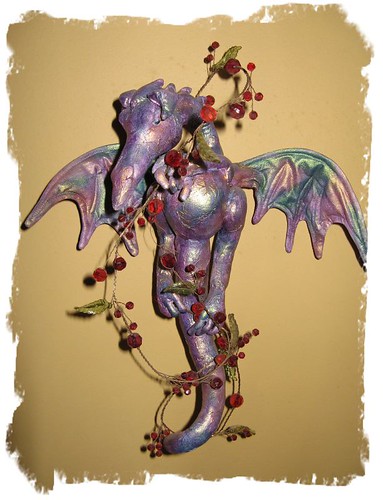
just because......
(because I'm sick of sorting sewing things and needed a small distraction)

Friday, 9 November 2007
thoughts on rusting fabrics
I had an interesting query from TheeCoyote on flickr on one of the photos I'd posted earlier this year of my rusted fabric:
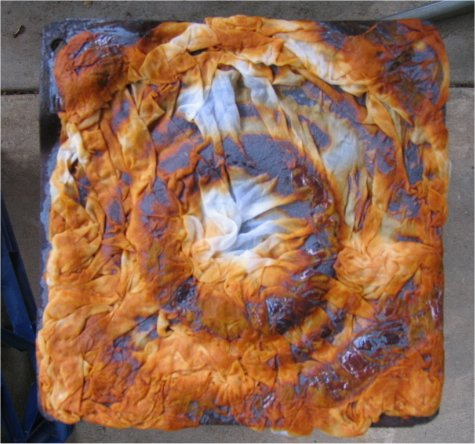
She asked if I was able to fix the colour, do the fibers become damaged at all and is it durable?
As so many textile artists are trying their hand at rusting, I thought it might be good to bring up the subject here.
First - the stains appear to be quite permanent, I've washed all pieces in hot soapy water several times and nothing leached out (otherwise rust removal companies would be out of a job VBG)
Rust is the common name for the compound, iron oxide Fe2O3, the rusting is the process of corrosion that occurs when pure iron (steel) oxygen and water get together.
The information I've found on-line seems to indicate that Iron oxide pigment can be used as a textile dye for topical application.
The Prairie Fibers Co
has an information page on rusting - they also advise wearing a mask and gloves when dealing with natural rust: "Iron in this form wants to bind with your hemoglobin blocking all available sites for oxygen, .... You can become gravely ill from too much contact with raw iron products"
The Paula Burch site "All About Hand Dyeing" quotes:
"You can dye cotton fabric with metals alone, and no other dyes, by allowing iron to rust while in contact with the fabric, generally using salt and/or vinegar. A potential problem is that fact that the large amounts of metal ions can actually damage the fabric. Do not expect long wear from fabric prepared in this way. Limiting the exposure of the fiber to the metal can control the amount of damage at an acceptable level. Also note that the metal in the fabric can dull scissors and needles used with it."
Getting back to my pieces - the fibres are in good condition at this stage, however,
it's been really hard to locate much more information on the long term effects of the rust on the fabric - I've searched on conservation sites and they seem mainly concerned with rust removal and the effects of chemicals used in the removal.
They do advise when framing fabrics not to use tacks or staples which could rust and will cause deterioration because of continued contact with the fabric.
So I have no idea how long this fabric will be good for, I personally wouldn't feel comfortable using it in a heirloom quilt which I would hope to pass through generations, but then that could also relate to some acrylic fabrics and threads.
Which brings up the subject of todays 'art' quilts, we are using so many new techniques, paints, chemicals, surely it will be only time that eventually tells us how successful these are...
and if we buy (or worse! sell!) a quilt for big bucks, how long do we (and our customers) expect it to last?
As an artist does it worry you that your work may have a limited life.
Do artists have the right to ask lots of money for a piece of work which may be turn out to be ephemeral in comparison to textile art made using natural materials or in comparison to traditional art (canvas and paint)
(there it is again, the "us and them" textile artists v. paint artists)
just remembering that I also have some iron oxide in the shed from my potting days, (and cobalt and ...and....)
now that could just set off a whole new train of experiments....
She asked if I was able to fix the colour, do the fibers become damaged at all and is it durable?
As so many textile artists are trying their hand at rusting, I thought it might be good to bring up the subject here.
First - the stains appear to be quite permanent, I've washed all pieces in hot soapy water several times and nothing leached out (otherwise rust removal companies would be out of a job VBG)
Rust is the common name for the compound, iron oxide Fe2O3, the rusting is the process of corrosion that occurs when pure iron (steel) oxygen and water get together.
The information I've found on-line seems to indicate that Iron oxide pigment can be used as a textile dye for topical application.
The Prairie Fibers Co
has an information page on rusting - they also advise wearing a mask and gloves when dealing with natural rust: "Iron in this form wants to bind with your hemoglobin blocking all available sites for oxygen, .... You can become gravely ill from too much contact with raw iron products"
The Paula Burch site "All About Hand Dyeing" quotes:
"You can dye cotton fabric with metals alone, and no other dyes, by allowing iron to rust while in contact with the fabric, generally using salt and/or vinegar. A potential problem is that fact that the large amounts of metal ions can actually damage the fabric. Do not expect long wear from fabric prepared in this way. Limiting the exposure of the fiber to the metal can control the amount of damage at an acceptable level. Also note that the metal in the fabric can dull scissors and needles used with it."
Getting back to my pieces - the fibres are in good condition at this stage, however,
it's been really hard to locate much more information on the long term effects of the rust on the fabric - I've searched on conservation sites and they seem mainly concerned with rust removal and the effects of chemicals used in the removal.
They do advise when framing fabrics not to use tacks or staples which could rust and will cause deterioration because of continued contact with the fabric.
So I have no idea how long this fabric will be good for, I personally wouldn't feel comfortable using it in a heirloom quilt which I would hope to pass through generations, but then that could also relate to some acrylic fabrics and threads.
Which brings up the subject of todays 'art' quilts, we are using so many new techniques, paints, chemicals, surely it will be only time that eventually tells us how successful these are...
and if we buy (or worse! sell!) a quilt for big bucks, how long do we (and our customers) expect it to last?
As an artist does it worry you that your work may have a limited life.
Do artists have the right to ask lots of money for a piece of work which may be turn out to be ephemeral in comparison to textile art made using natural materials or in comparison to traditional art (canvas and paint)
(there it is again, the "us and them" textile artists v. paint artists)
just remembering that I also have some iron oxide in the shed from my potting days, (and cobalt and ...and....)
now that could just set off a whole new train of experiments....
Subscribe to:
Posts (Atom)
